Short answer
A load cell brake measures how hard you press, so your foot learns a braking pressure instead of a pedal position. It is mainly a consistency upgrade, not a promise of a faster lap.
- Choose a load cell or hydraulic brake if you want to hit the same braking pressure lap after lap. Every pedal set in our lineup except one reads force or pressure at the brake.
- A position-sensing brake reads how far the pedal moves. In our lineup that is the stock brake of the Asetek Initium, the lowest-priced pedal set we carry, and Asetek makes load cell and hydraulic brake kits for it.
- Throttle and clutch usually read position. The brake is the pedal the makers build around a load cell.
Force or position
A potentiometer or a Hall sensor reads how far the pedal has moved. A Hall sensor does it with a magnet, so nothing rubs, which makes it smooth and reliable. Even so, a brake that reads position can vary if the pedal travel shifts, parts wear or the mounting flexes. A load cell reads how hard you press, so the braking point is set by pressure instead.
Force and travel. A position sensor reads how far the pedal moves; a load cell reads how hard you press, so your foot learns a braking pressure instead of a pedal position.
- Reads how far the pedal moves, not how hard you press.
- Sensor reads position.
- Illustrative shape.
Force and travel. A position sensor reads how far the pedal moves; a load cell reads how hard you press, so your foot learns a braking pressure instead of a pedal position.
- Reads how hard you press, so your foot learns a braking pressure instead of a pedal position.
- Sensor reads force.
- Illustrative shape.
The independent explainer we read describes the gain as repeatability. It cites iRacing drivers whose fastest lap barely changed after the switch while their laps got more consistent. It is not a shortcut to lap time.
What each pedal set measures
Every pedal set in our configurator, with what its brake senses and the maker’s own brake figure. Prices are on each brand page.
| Pedal set | The brake senses | Maker’s brake figure | Runs on |
|---|---|---|---|
| Asetek Initium | Position (Hall sensor) | Body takes up to 140 kg of force | PC |
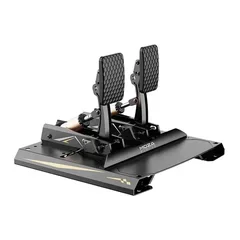
| MOZA SRP2 | Angle sensor for the start of the stroke, then a load cell | 0–100 kg load cell | PC · Xbox to be confirmed |
| MOZA CRP2 | Angle sensor for the start of the stroke, then a load cell | 0–200 kg load cell | PC · Xbox via base, game-dependent |
| MOZA mBooster | Dual load cells; a motor drives the pedal (active) | Dual 200 kg load cells | PC |
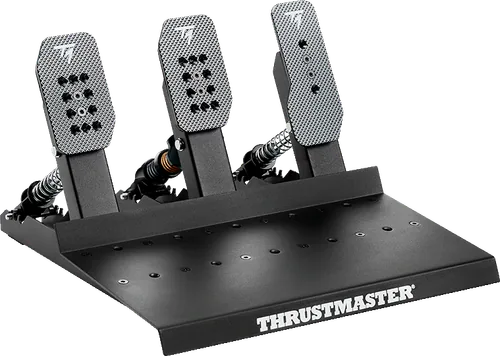
| Thrustmaster Raceline Pedals III LC | Load cell | 25–100 kg at the pedal, four setups | PC · PlayStation through a Thrustmaster base · Xbox through a Thrustmaster base |
| Cube Controls SP01 Core | Load cell | 200 kg load cell | PC |
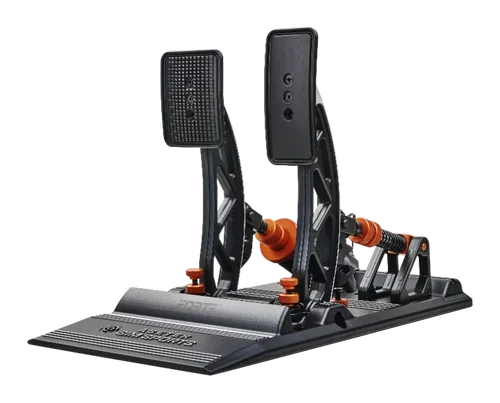
| Asetek Forte | Load cell, two-stage brake | Up to 180 kg at the pedal plate | PC |
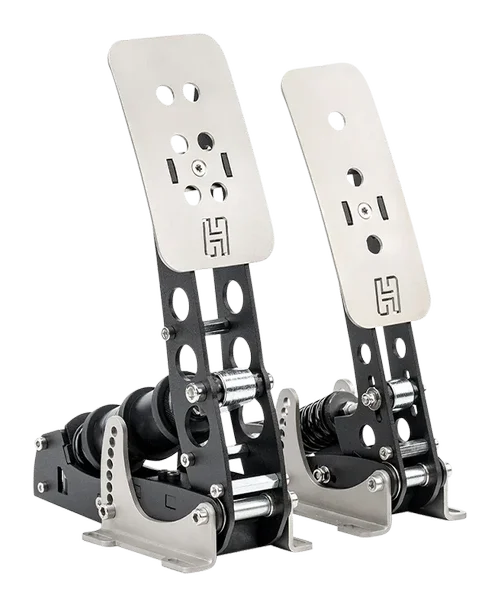
| Heusinkveld Sprint | Load cell; a spring first, then rubbers | Max brake force up to 65 kg | PC |
| Heusinkveld Ultimate+ | Load cell with hydraulic dampers | Up to 140 kg from a 200 kg cell | PC |
| Asetek Invicta T.H.O.R.P. | Hydraulic pressure sensor, 0–100 bar | About 180 kg at the pedal | PC |
Makers rate brake force differently: a load cell’s range is not the force you can put through the pedal. The next section shows how to compare them.
How much force
Compare brake force at the pedal, not the size of the load cell. A 200 kg cell can sit in a pedal that tops out at 140 kg.
- Heusinkveld Sprint: up to 65 kg from a 120 kg cell. Heusinkveld says 65 kg may be enough for road cars, lower junior formula and slower GT cars.
- Heusinkveld Ultimate+: up to 140 kg from a 200 kg cell, aimed at fast formula cars and quick GT cars.
- Thrustmaster Raceline LC: 25 to 100 kg in four setups, with a preload dial in 5 kg steps.
- Asetek Forte and Invicta: up to about 180 kg at the pedal plate.
- MOZA SRP2 and CRP2: MOZA states the cell range (0–100 kg and 0–200 kg), not the force at the pedal.
What the feel is made of
The sensor decides what the brake measures. Springs, rubbers and hydraulics decide what it feels like to push.
- Springs and elastomers. MOZA and Thrustmaster tune the feel with swappable springs and elastomers.
- Two stages. The Asetek Forte has a soft stage, then a hard wall like a race car’s brake. The Heusinkveld Sprint uses a coil spring for the pad-to-disc gap, then rubbers take the load.
- Hydraulic. The Asetek Invicta runs a real hydraulic line with an automotive pressure sensor. The Heusinkveld Ultimate+ keeps a load cell and adds hydraulic dampers, so a fast press meets more resistance than a slow one.
- Active. The MOZA mBooster moves the pedal with a motor and plays ABS, wheel lock-up and traction control through it. The PHF vibration kit adds ABS and wheel-slip vibration to the SRP2 and CRP2.
Choosing, trying, buying
- PC. Every pedal set here runs on a Windows PC.
- PlayStation. The Thrustmaster Raceline Pedals III LC runs on PS5 and PS4 through a Thrustmaster base. Our PlayStation guide has the full build.
- Xbox. The MOZA CRP2 works through a MOZA base, depending on the game.
Every pedal set here fits both the SimWerk Core and the SimWerk Grand; for the Cube Controls SP01 Core we confirm the mounting in your quote. Pick the wheelbase first if you haven’t: our wheelbase guide shows which wheels and platforms go with each.
SimWerk is an authorized MOZA Racing dealer. For wheels, bases and pedals, discuss your setup before you order. SimWerk is also an authorized Thrustmaster dealer. Build any pedal set into your rig in the configurator and send it to us for a quote.
MOZA pedalsAsetek RacingHeusinkveldThrustmasterCube Controls